
 |
Louis Pérez helps to explain
why US reflexes towards Cuba are so visceral
Cuba in the American Imagination: Metaphor and the Imperial Ethos
Louis A. Pérez Jr.
2008, University of North Carolina Press
369 pages (hardback)


Reviewed by Gavin O’Toole
FROM THE very first sentences, we are left in no doubt about the intentions of Louis Pérez in this excellent and highly recommended study of the relationship between the US and its first colony: “Cuba occupies a special place in the history of American imperialism. It has served as something of a laboratory for the development of the methods by which the United States has pursued the creation of a global empire.”
The timing of Cuba in the American Imagination is also auspicious, appearing when, perhaps for the first time in a generation, there are hints that a new dialogue between Washington and Havana may be possible because of political change on both sides of the Florida straits. Yet at the same time, absurd Republican efforts to associate Barack Obama with socialism – even, bizarrely, Marxism – do not augur well for any effort to change the tenor of the official US narrative.
Pérez explores the formative but also anomalous role played by the island in the US psyche since the early 19th century, by which politicians and imperial mythmakers increasingly turned its possession into a simple and prophetic question of national well-being or even, to use that cherished US phrase, destiny.
The author explores the ways in which the men and women implicated in affairs of state – from politicians to officials, editors, artists and industrialists – were persuaded that the possession of Cuba was a matter of absolute national necessity, to the extent that whatever happened on the island somehow impacted US interests. Like most imperial crusades, this sentiment evolved into an enduring belief – one that persists in other forms – that the desire to wrest control of Cuba from Spain, consummated with the intervention in 1898, was born out of a sense of righteous moral purpose.
Woodrow Wilson, the then US president, later wrote that intervention had not been aimed at material aggrandisement, but to drive away an oppressor as part of a virtuous and benign republican foreign policy. According to Pérez, this belief in moral discharge became a potent legacy of 1898 and passed into the “master narrative” of US historiography, another self-confirmation of national virtue.
As empire had come late to the Americans, and as Cuba was the American empire’s first, treasured possession, the island became fixed as a jewel in the latter’s crown to such an extent that its subsequent loss under Castro coloured all subsequent engagements, especially during the Cold War, when rival contemporary empires squared up to carve out spheres of influence across the globe. Like a child who has lost a special trinket, Washington has never since reconciled itself to Cuban independence.
Metaphors and motifs
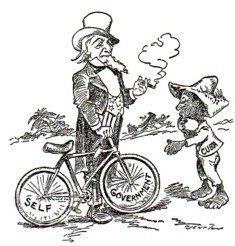
The author looks at the metaphors and motifs in texts and images from the 19th and 20th centuries that, together, created and maintained a coded mode of persuasion sustaining an imperialist logic in the Caribbean island, and provides valuable theoretical reflections on the role of metaphor in imperial narratives. The book is brimming with fascinating and revealing newspaper cartoons and other images that speak loudly about US attitudes.
While concentrating on the period from the late 19th-century to the 1930s, Pérez does include a fascinating chapter on the impact of the Cuban revolution of 1959 on this narrative that will be of particular interest to many readers.
One of the most important observations the author makes concerns the difficulties posed by change to US paradigms about Cuba: not only did the revolution render old paradigms unusable but, as Pérez points out, the very idea of a Cuba for Cubans no longer disposed to accommodate US needs was difficult for Americans to contemplate. As a result, the revolution simply wrought havoc on north American self-esteem. He writes:
“So fully were the Americans implicated in the logic of their own metaphors that they failed to discern – or perhaps they were unable to discern – the revolution as a phenomenon of Cuban empowerment.” [pp. 240-241]
Fittingly, the author concludes by touching upon more contemporary and recurrent reflections of US colonial discourse, and in particular the presumptuousness of the most recent incarnation of the narrative: a raft of generously-funded policies preparing for a post-Castro “transition”, from the projects funded by USAID to preparations for “transitional elections” under the auspices of the International Foundation for Electoral Systems. Pérez writes:
“All in all, it was an astonishing presumption of entitlement, among both policy makers and officials distributing the money and the academics and administrators accepting the money – always no doubt in the best interests of the Cuban people. That the Americans in the twenty-first century could presume that planning the future of Cuba without the participation of any of the 11 million people who lived on the island was an attitude worthy of the arrogance of their predecessors in the nineteenth century.” [p. 274]
Cuba in the American Imagination is one of the most important contributions to the debate about US-Cuban relations for a long time. By providing the discursive context for visceral, and at times irrational, American responses to developments in a small island off its vast coast, this text should be required reading for policymakers, Latin Americanists (particularly those at the University of Miami) and Cuban exiles – everywhere.
Gavin O’Toole is Editor of the Latin American Review of Books
Categories: Caribbean, Cuba, North America, United States